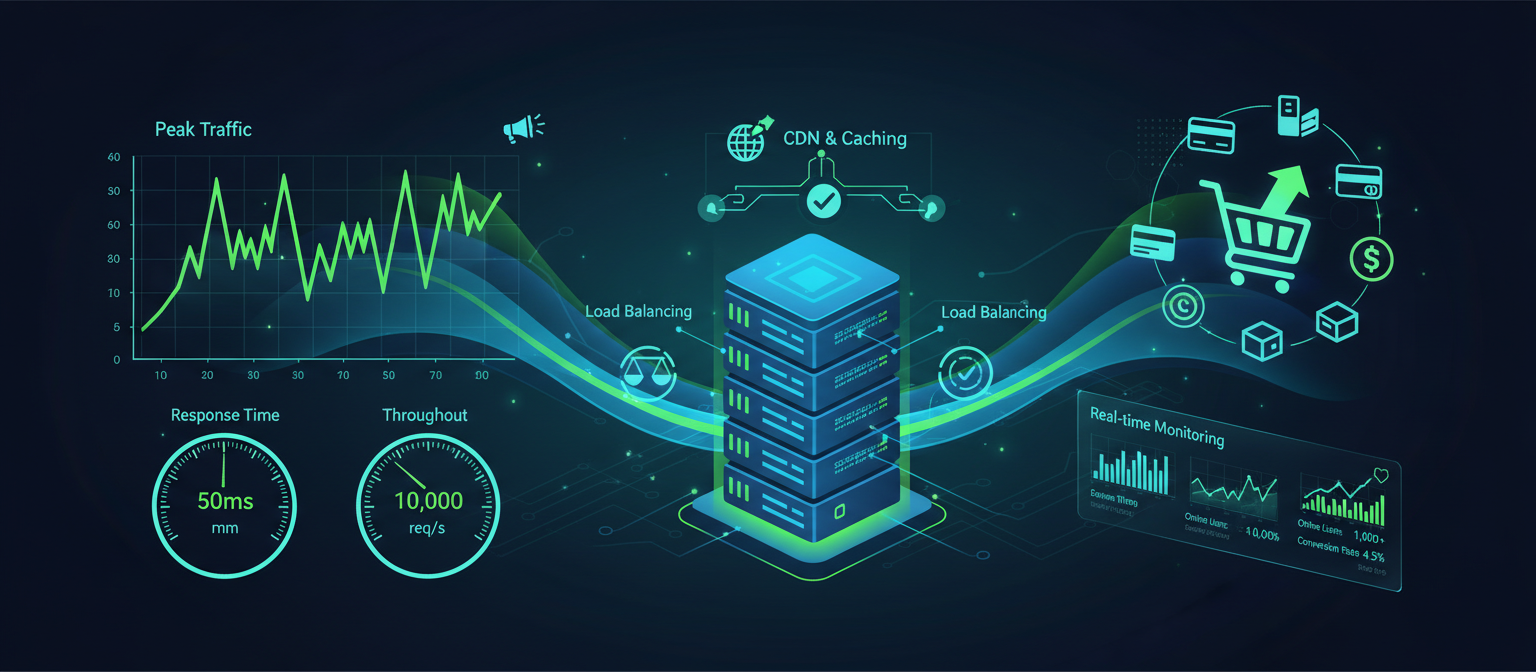
The Black Friday Challenge: When Traffic Becomes a Tsunami
In 2024, Black Friday generated $9.8 billion in online salesaccording to Adobe Analytics —a 7.5% increase from the previous year. When Amazon's servers handle 1,000 orders per second during peak hours, they're managing a digital tsunami that can crash unprepared e-commerce sites in minutes.
When Shopify Plus merchants process $4.1 billion in sales during Black Friday weekend, they're orchestrating complex systems that must scale 100x normal capacity. According to Cloudflare research , sites with proper optimization achieve 40% higher conversion rates during peak traffic.
This guide will show you how to build e-commerce systems that survive Black Friday and thrive under extreme load.
💡 The Performance Optimization Advantage
Optimized sites achieve 40% higher conversion rates during peak traffic events. The difference between sites that survive and those that crash?Proper performance optimization and scaling strategies.
After optimizing e-commerce systems for companies processing billions in annual sales, I've identified the patterns that separate high-performance sites from traffic casualties.
E-commerce Performance Fundamentals: The Foundation of Scale
E-commerce performance isn't just about speed—it's about building systems that maintain performance under extreme load while delivering seamless user experiences. Understanding the fundamentals is crucial for surviving peak traffic events.
The Performance Optimization Pyramid
Frontend Optimization
📊 Core Web Vitals
LCP < 2.5s, FID < 100ms, CLS < 0.1
🖼️ Image Optimization
WebP, lazy loading, responsive images
Backend Performance
🗄️ Database Optimization
Query optimization, indexing, connection pooling
🚀 API Performance
Response time < 200ms, efficient data structures
Infrastructure Scaling
📈 Auto-Scaling
Dynamic resource allocation based on load
🌐 CDN Strategy
Global content delivery, edge caching
E-commerce Performance Architecture
High-Performance E-commerce Stack
💡 Pro Tip: Performance Budget
Set strict performance budgets and monitor them continuously. A 100ms delay in page load can reduce conversion rates by 7%.
Traffic Scaling Strategies: Preparing for the Storm
Scaling for Black Friday isn't just about adding servers—it's about designing systems that can handle 100x normal traffic while maintaining performance and reliability.
Scaling Strategy Framework
1. Horizontal Scaling: Adding More Servers
Auto-Scaling Groups: AWS ASG, Google Managed Instance Groups
Load Balancers: Application Load Balancer, CloudFlare
Container Orchestration: Kubernetes, Docker Swarm
Database Scaling: Read replicas, connection pooling
2. Caching Strategy: Reducing Load
CDN Caching: CloudFlare, AWS CloudFront, Fastly
Application Caching: Redis, Memcached, in-memory caching
Database Caching: Query result caching, connection pooling
Browser Caching: Static asset caching, service workers
3. Traffic Management: Controlling the Flow
Rate Limiting: API throttling, user-based limits
Queue Management: Message queues, async processing
Circuit Breakers: Fail-fast patterns, graceful degradation
Traffic Shaping: Priority queues, resource allocation
Black Friday Preparation Timeline
6-Month Black Friday Preparation
Infrastructure Optimization: Building for Scale
Infrastructure optimization isn't just about hardware—it's about designing systems that can dynamically adapt to changing load patterns while maintaining cost efficiency.
Infrastructure Scaling Patterns
1. Microservices Architecture
Service Decomposition: Product catalog, cart, checkout, payment
Independent Scaling: Scale services based on demand
Fault Isolation: Service failures don't crash entire system
Technology Diversity: Use best tool for each service
2. Database Optimization
Read Replicas: Distribute read load across multiple instances
Connection Pooling: Efficient database connection management
Query Optimization: Index optimization, query analysis
Caching Layers: Redis, Memcached for frequently accessed data
3. CDN and Edge Computing
Global Distribution: Serve content from edge locations
Edge Caching: Cache static and dynamic content
Edge Computing: Process requests closer to users
DDoS Protection: Built-in traffic filtering and mitigation
Real-Time Monitoring and Response: Staying Ahead of Problems
During peak traffic events, problems can escalate from minor issues to system-wide failures in minutes. Real-time monitoring and automated response systems are crucial for maintaining performance.
Monitoring Strategy
Real-Time Monitoring Stack
Black Friday Success Stories: What Actually Works
Let's examine three real Black Friday implementations—one breakthrough, one challenge, and one failure. Each reveals critical lessons for peak traffic management.
Case Study 1: Shopify Plus Merchants' $4.1 Billion Weekend
✅ The Success Story
Platform: Shopify Plus
Challenge: Handle $4.1B in sales over Black Friday weekend
Solution: Auto-scaling infrastructure with global CDN
Results: 99.99% uptime, 0.1% error rate
What they did right:
- • Proactive scaling: Pre-scaled infrastructure before traffic spikes
- • Global CDN: Served content from edge locations worldwide
- • Real-time monitoring: Continuous performance tracking and alerting
- • Graceful degradation: Maintained core functionality during peak load
Preparing for Peak Performance: Your Black Friday Roadmap
Black Friday success isn't about luck—it's about systematic preparation, performance optimization, and real-time response capabilities. The e-commerce companies that master peak traffic management will dominate their markets.
Ready to Conquer Black Friday Traffic?
Start with performance optimization, implement proper scaling, and monitor everything. The future belongs to e-commerce sites that can handle any traffic spike.
The e-commerce revolution depends on systems that can scale. Companies that master peak traffic management today will define the future of online commerce tomorrow.