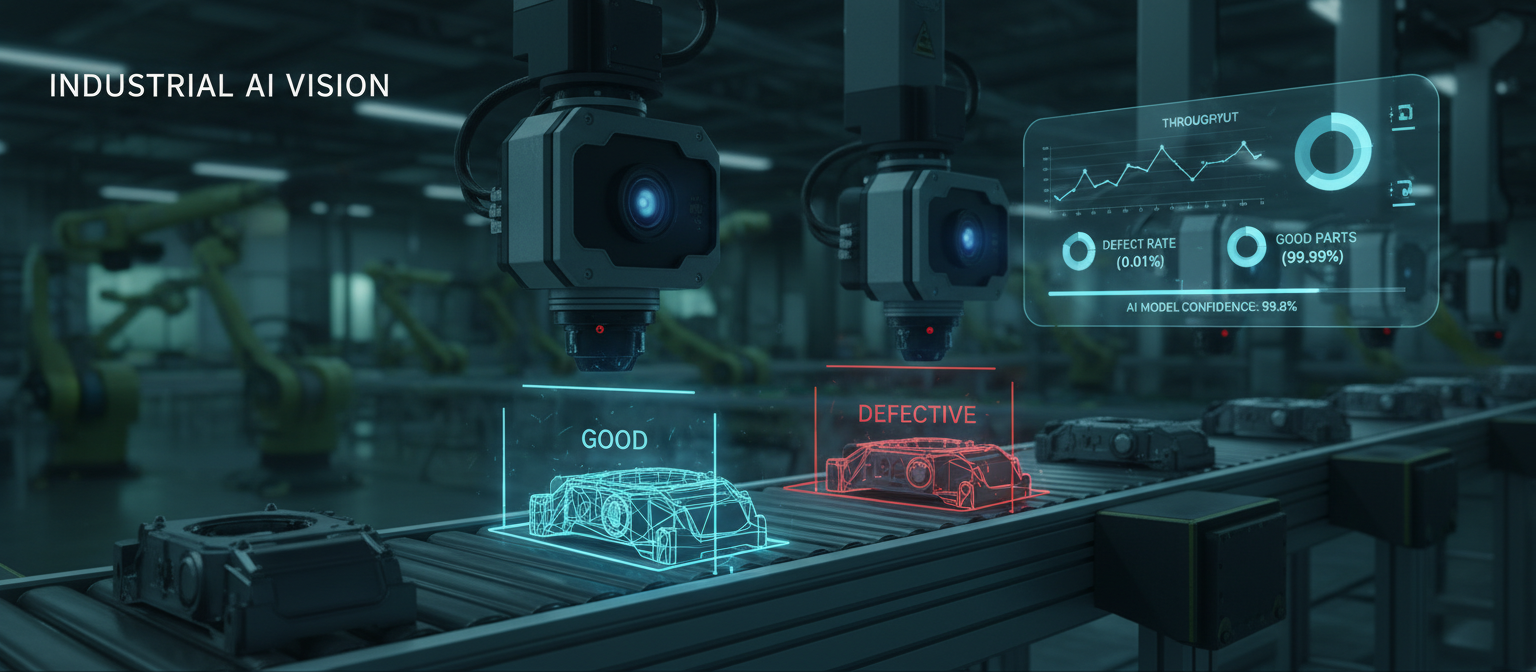
The Manufacturing AI Revolution: From Human Eyes to AI Vision
In 2024, manufacturers using AI-powered quality control systems reduced defect rates by67% while increasing inspection speed by 300% according toMcKinsey research . When Tesla implemented computer vision for battery cell inspection, they achieved 99.9% accuracy in defect detection while processing 1,000 cells per minute—impossible for human inspectors.
When Bosch deployed AI vision systems across their manufacturing lines, they reduced inspection costs by 40%and eliminated human error in critical safety components. According to NVIDIA manufacturing research , AI vision systems can detect defects 10x smaller than human inspectors.
This guide will show you how to implement computer vision systems that transform manufacturing quality control.
💡 The Manufacturing AI Opportunity
AI-powered quality control can reduce manufacturing costs by 25%while improving product quality and reducing recalls. AI vision systems detect defects 10x smaller than humans. The difference between successful implementations and failures?Proper system design and integration with existing manufacturing processes.
After implementing computer vision systems for manufacturers producing millions of units annually, I've identified the patterns that separate successful AI implementations from expensive failures.
Computer Vision Fundamentals: The Foundation of Manufacturing AI
Manufacturing computer vision isn't just about detecting defects—it's about building systems that can operate reliably in industrial environments while maintaining high accuracy and speed.
The Manufacturing Computer Vision Stack
Image Acquisition
Image Processing
Integration & Control
Quality Metrics
Manufacturing Computer Vision Architecture
Industrial Computer Vision System
⚠️ Industrial Environment Challenges
Manufacturing environments present unique challenges: vibration, dust, temperature variations, and lighting changes that can affect AI model performance.
AI-Powered Quality Control: Beyond Human Capabilities
AI-powered quality control systems can detect defects that human inspectors miss while operating 24/7 with consistent accuracy. The key is designing systems that complement human expertise rather than replace it entirely.
Quality Control Applications
1. Surface Defect Detection
Scratch Detection: Surface imperfections, cosmetic defects
Contamination: Foreign particles, dirt, oil stains
Color Variations: Paint defects, discoloration
Texture Analysis: Surface roughness, finish quality
2. Dimensional Inspection
Size Measurement: Length, width, height verification
Shape Analysis: Geometric accuracy, form verification
Position Accuracy: Hole placement, feature alignment
Tolerance Checking: Specification compliance, quality gates
3. Assembly Verification
Component Presence: Missing parts, incomplete assembly
Orientation Check: Correct positioning, alignment
Connection Verification: Proper assembly, secure connections
Label Verification: Correct labeling, barcode scanning
AI Model Development for Manufacturing
Manufacturing AI Model Pipeline
Advanced Defect Detection: The Art of Finding the Unseen
Advanced defect detection goes beyond simple classification—it's about identifying subtle defects that could cause failures in the field while minimizing false positivesthat slow down production.
Advanced Detection Techniques
1. Anomaly Detection
Autoencoder Networks: Reconstruction error-based detection
One-Class SVM: Normal pattern learning, anomaly identification
Isolation Forest: Unsupervised anomaly detection
Use Cases: Novel defect types, unknown failure modes
2. Multi-Scale Analysis
Pyramid Networks: Multi-resolution feature extraction
Attention Mechanisms: Focus on relevant image regions
Feature Fusion: Combining different scale features
Use Cases: Complex defects, multi-level inspection
3. Temporal Analysis
Video Analysis: Frame-by-frame defect tracking
LSTM Networks: Sequential pattern recognition
Optical Flow: Motion-based defect detection
Use Cases: Dynamic defects, process monitoring
Production Implementation: From Lab to Factory Floor
Implementing computer vision systems in production requires careful integration with existing manufacturing processes while ensuring reliability and maintainability.
Implementation Strategy
1. Pilot Implementation
Proof of Concept: Small-scale testing, validation
Performance Metrics: Accuracy, speed, reliability
Integration Testing: PLC communication, data flow
User Training: Operator education, maintenance procedures
2. Production Deployment
Scalable Architecture: Multi-line deployment, centralized management
Monitoring Systems: Performance tracking, alert management
Maintenance Procedures: Model updates, calibration schedules
Continuous Improvement: Data collection, model refinement
3. Optimization and Scaling
Performance Tuning: Model optimization, hardware acceleration
Cost Optimization: Resource utilization, efficiency improvements
Expansion Planning: Additional lines, new product types
ROI Measurement: Cost savings, quality improvements
Manufacturing Success Stories: What Actually Works
Let's examine three real manufacturing implementations—one breakthrough, one challenge, and one failure. Each reveals critical lessons for successful computer vision deployment.
Case Study 1: Tesla's Battery Cell Inspection Revolution
✅ The Success Story
Company: Tesla
Challenge: Inspect 1,000+ battery cells per minute
Solution: AI-powered computer vision with custom models
Results: 99.9% accuracy, 300% speed improvement
What they did right:
- • Custom model development: Trained specifically for battery defects
- • High-speed processing: Optimized for production line speeds
- • Integration excellence: Seamless PLC and MES integration
- • Continuous learning: Model updates based on new defect types
The Future of Smart Manufacturing: Your AI Vision Roadmap
Computer vision in manufacturing isn't just about automation—it's about building intelligent systems that improve quality, reduce costs, and enable new manufacturing capabilities. The companies that master AI vision will define the future of manufacturing.
Ready to Transform Manufacturing with AI Vision?
Start with pilot implementations, focus on high-impact use cases, and build for scale. The future belongs to manufacturers that can see beyond human limitations.
The manufacturing revolution depends on AI vision. Companies that master computer vision today will define the future of smart manufacturing tomorrow.